
What is Content Marketing? Basic & Advanced Strategies in 2026
- December 19, 2025
-
 Anchita Bhattacharyya
- Marketing

Is content marketing all about writing blogs, putting keywords, and praying for a high ranking? NO! It’s a lot more than that. Literally, content marketing is a complete strategy to develop various forms of content and use marketing tactics to share them with your readers/ customers. It is beneficial to engage and attract customers to your brand.
When promoting your brand and products through blogs, social media posts, videos, podcasts, etc., it engraves your name in customers' minds and helps them make a buying decision. With a well-rounded content marketing strategy, brands can generate awareness, promote their mission & vision, products, initiatives, and add value to their customers’ searches.
We have gone through various in-house research before bringing this blog to you. In our research, we found that roughly 67% B2B (business-to-business) marketing professionals state that B2B specific content has boosted their customer engagement and lead generation. Yes, content does have this kind of power. But the right one.
To know which type of content is right for your business, how to jot out a strategic content marketing plan, tips and trends of content, and many other interesting things, give GoContento’s comprehensive content guide a thorough read.
What is Content Marketing? How do Content Marketers Perceive it Today?
Simply put, content marketing is the production and distribution of different forms of relevant and valuable content to attract/ retain a certain segment of customers to drive sales and profitability.
The purposes of content marketing are:
- Attract a relevant audience
- Engage them
- Introduce your products or services
- Develop trust
- Convert to long-term customers
Did you know that businesses with blog posts receive 67% more leads than businesses without them? Content is not just about blogs, though.
Other forms of content include,
- Assets like case studies, white papers & guides
- News
- Product/ service descriptions
- Emailers
- Social media posts
- Videos
- Podcasts
- Infographics
And so much more.
We will be describing them in detail sometime soon in this blog.
Today, content marketing is seeing a rapid transformation with AI innovation. When tools like ChatGPT and Perplexity were introduced, writers feared job security. But, honestly, AI is used to enhance content marketers’ tasks and not replace them. AI is more of a co-creator, helping with research, strategy building, handling repetitive tasks, etc. Whereas the mind and creativity come from an actual human.
As per Google’s E-E-A-T (Experience, Expertise, Authoritativeness, and Trustworthiness), human content will always be preferred by search engines. So, worry not, learn from modern content professionals how to use AI to drive productivity, hyper-personalize content largely, and lean on data-backed creativity.
Let’s Learn How Content Marketing Works
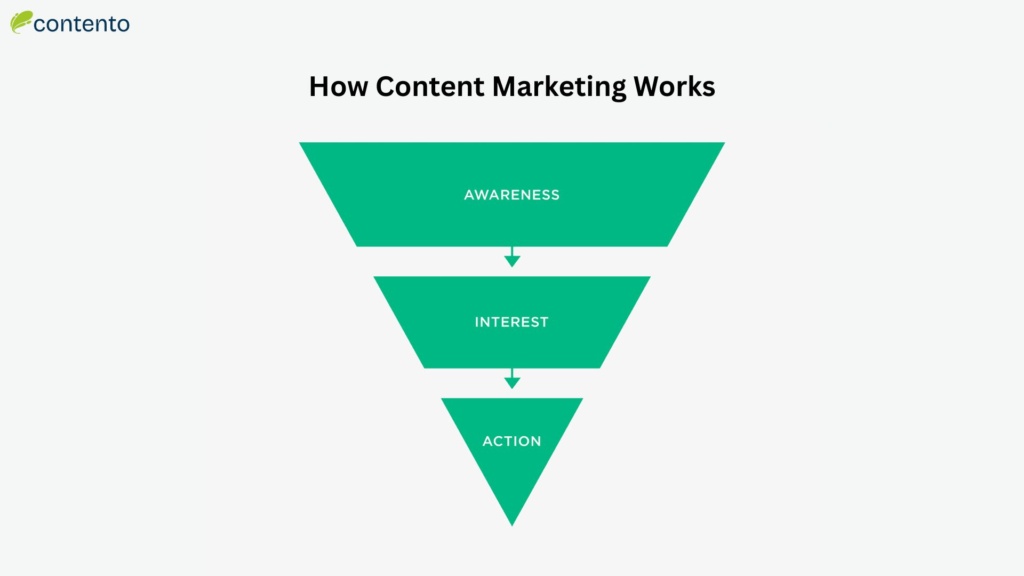
Delivering the right form of content to the customers at the right stage of the sales cycle is vital. This ensures that whatever product or service you are selling catches their eyes, triggers their interests, and guides them to buy it.
First stage, awareness stage
In this stage, the content needs to be educational, including how-tos and guides. It should offer a solution to your customer’s search concern. Once you start addressing their pain points, answering their questions, and solving their challenges, they gain interest in your brand.
For example: A renowned restaurant creates an article on “What should be on your Christmas party menu this year?”
Second stage, the consideration stage
Now you must put together content that delves deep to offer helpful information to your readers and aid in marketing efforts. This includes case studies, product handbook, how-to blogs & videos, etc. The content should clearly state your business offerings, product features, functions, and so on.
For example: A plumbing company posts a guidebook on “What Qualities You Must Look For In Your Plumber?” OR “What Plumber’s From ‘A’ Company Offers That Others Don’t?”
Third stage, closing stage
When your potential customer is ready to buy, you use informational content to provide other extra information, useful interactive videos, or research reports of your products/ services, to close the sale.
For example: An interior design company shares videos of their recent works on websites, social media channels, or even attaches them to emails of potential customers, to display varied expertise.
What are the Types of Content Marketing?
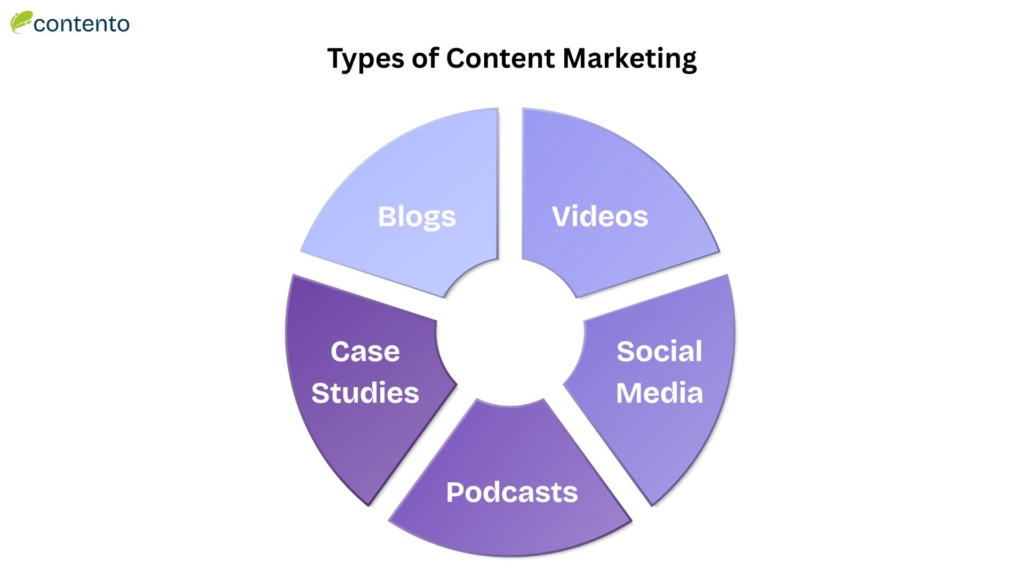
Strategic content planning includes one very important thing, which is understanding what content to use, where, and when. After understanding what you want from your content marketing, you need to focus on choosing the correct content types for your distribution channels and goals.
Blogs
This form of content brings organic traffic to the brand. Blogs also share insights, develop credibility, and display thought leadership. It’s a versatile, affordable, and multi-purpose way to connect with customers. A well-written blog customer journey from awareness to conversion.
Most suitable for: SEO, brand awareness, and education.
Videos
A flexible mode of communication, videos simplify complex ideas, kindle customer interest, and drive conversions. You can use platforms like YouTube, TikTok, and Instagram to circulate short-form videos. You can also use long-form videos for product/ service explanations.
Most suitable for: Brand storytelling and product demos.
Case Studies
You can use assets like case studies and white papers to provide in-depth analysis to customers. This form of content is especially suited for B2B companies, wherein the clients are professionals and possess initial knowledge about your product. You can attach case studies to emailers and attract more customers.
Most suitable for: Website, emailers
Podcasts
Audio-first storytelling is a great way to introduce your brand and products to customers. You can explore multiple topics, such as industry trends, thought leadership, customer stories, and founders' perspectives, through podcasts.
Most suitable for: Generating trust and targeting niche audiences.
Social Media
Promoting your brand on relevant social media channels, like Facebook, LinkedIn, X, Instagram, etc., can boost customer engagement and brand awareness significantly. The trick is to use platform-specific content; for example, use educational, insightful content for LinkedIn, whereas Instagram users are more inclined towards fun, interactive content.
Most suitable for: Live engagement, brand community development.
Updated Content Marketing Strategy for 2026
An effective, engaging, and converting content marketing strategy includes the following steps:
1. Segmentation of customers based on their behavior, history, location, age, and many other parameters. You can also utilize AI and machine learning in this stage to accomplish this task quickly, accurately, and at scale. Customer segmentation helps to identify their interest, tailor specific content, and engage them at their preferred channel.
2. Organize content according to the stages of the customer journey. This mostly requires the following steps:
- Awareness, brand introduction through articles, long-form videos to build trust, and imbibe the brand’s name into their minds.
- Consideration, when customers are looking for solutions. You can use product demo videos, webinars, etc., to offer guidance and market your product to them.
- Decision: When the customer is almost going to buy, use targeted ads, product videos, and customer testimonials to draw them in.
3. Choose the right content form to match your consumer’s habits and brand’s marketing goals. For SEO and product education, you can use blogs; also, product teasers are great short-form content for social media engagement. Blogs, case studies, etc., can also be repurposed across multiple platforms and in several forms.
4. Next, and a key step, is to set Key Performance Indicators, KPIs, that align with your business goals. Some common KPIs are,
- Engagement metrics like comments, likes, shares, and website visits.
- Growth in organic traffic.
- Conversion rate.
- Number of sign-ups and/ or lead form submissions.
5. A good distribution plan lets your content shine and reach the maximum people. You need to consider the following channels:
- Owned: Blogs, social media, email marketing.
- Earned: Guest posts, backlinks, PR.
- Paid: Target ads, sponsored posts.
6. Once your content is posted, keep an eye on the performance metrics. You can get an idea of what content works and where, which ones need adjustments, etc. You can use this data for future content, allocate maximum budget for top-performing content type or platform, or adjust the message for improved performance.
What does a content marketer do?
A typical content marketer has the following KRAs:
- Storytelling and content development.
- SEO and analyzing the audience.
- Collaboration and designing campaign strategies.
- Being adaptable to changing trends and measuring performance.
Real-World Successful Content Marketing Examples
Red Bull, the energy-drink brand that apparently ‘gives you wings’ (inserting air quotes here), we all know it, right? The brand, instead of just marketing their energy drinks, tells stories and creates an experience through content. They emphasize not their products, but adventure sports that have a much larger audience. Some key aspects of their content marketing are:
- The Red Bulletin: A monthly magazine that displays Red Bull’s brand themes.
- Red Bull TV: Their video channel that uploads extreme sports content, lifestyle content, documentaries, etc.
- Content Pool: A media library that offers images and videos that audiences can access in exchange for their email addresses. This smart move generates leads.
With consistent and brand-aligned content, Red Bull is one of the top examples of brands that are smartly using content marketing and has 1 billion-plus content views across channels every month!
Spotify gained immense popularity when it launched Spotify Wrapped in 2023. Today, Wrapped has become a much-awaited annual tradition that delights audiences through:
- Curated musical yearbooks
- Personalized playlists
- Artist fan messages
- Merch discounts
- Brand new personalized data stories
Since 2023 Wrapped, Spotify has seen user engagement of over 90 million and brand favorability of 30%!
Benefits of Content Marketing
Leveraging a comprehensive content marketing strategy in your organization has numerous benefits. Let’s learn the most beneficial ones:
- Trusted leadership through content develops credibility.
- Boosts organic visibility and enhances SEO performance.
- Well-planned content at every stage of the customer journey leads to increased conversions.
- Through post-sale engagement, companies can decrease churn.
- Quick adaptability to transforming customer and market trends.
- By repurposing and effectively using content, brands can cut acquisition costs.
Content Marketing ROI
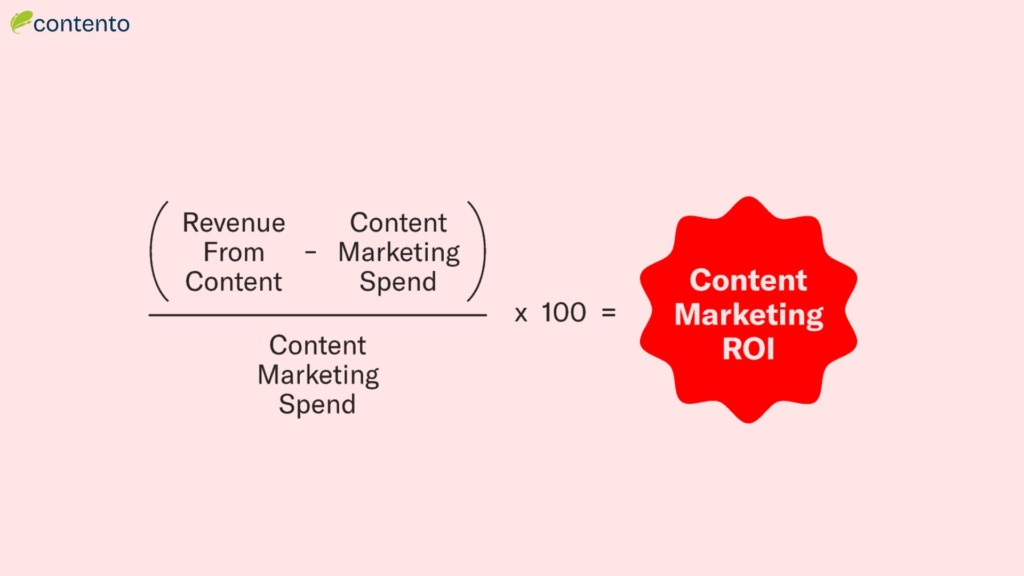
Good and well-placed content delivers attractive ROI for brands by not just promoting products, but creating a business impact.
- Value-added content ensures community building and long-term customer retention. Instead of just quick conversions, brands get high customer lifetime value (LTV), return customers, repeat purchases, referrals, and higher social proof.
- Personalizing insightful content for each stage of the customer journey reduces the time of sales cycles and decreases acquisition costs.
- Good content on owned media results in high conversion rates, from sign-ups to purchases.
- Brands need to leverage inbound marketing to increase sales, scalability, and stay ahead of the competition.
- Outbound marketing is not the way forward; instead, brands should focus on content marketing to stay fresh and relevant to consumers.
Related: 10 Best Enterprise Headless CMS For Your Website
Useful Content Marketing Tips/Trends of 2026
No matter what technologies we are experiencing now or what we’ll experience in the next five years, content is here to stay. Human-written, expertly crafted, valuable, and insightful content will always back up your brand and reach the target audience.
Let’s check out some 2026 content trends that you can add to your strategy:
- Marketers will leverage AI tools to generate, personalize, optimize, and distribute content. Though mostly repetitive tasks.
- AI will help to personalize content experiences at scale. You might see some marketing campaigns highly personalized to your preferences, much more than just changing names on emails!
- Data analysis in content marketing will be the key to predicting customer behavior and developing more targeted campaigns.
- The use of AI must be ethical; brands need to establish rules of AI use and display transparency. This will help to build better customer relations through reliable storytelling.
- Values such as sustainability, social responsibility, etc., will be in focus. Brands need to align their content marketing with these goals to reach varied consumers.
Some popular content formats will be:
- Short-form videos, especially on popular platforms like TikTok, Instagram, and YouTube.
- Interactive content like AR/VR, quizzes, etc.
- Omnichannel marketing to distributing content across various platforms.
- For better visibility, marketers need to optimize content for Q&A formats & natural language.
- To promote brand loyalty and direct engagement, brands will focus on building communities, like GitHub, Slack, etc.
What’s Next For Content Marketing?
Alongside tech innovations like AI and predictive analysis, content marketing strategies will also include basic human principles like empathy, care, and creativity. Even a few years back, stuffing high-volume keywords could help to rank your page. Not anymore! With Google’s E-E-A-T, genuine and value-added content will be the first priority.
Just like marketing pros, today’s consumers understand the difference between shallow and in-depth content marketing tactics. As a content marketer myself, I can completely understand how clever today’s audiences have become. They no longer fall for repetitive and monotonous content. Only fresh, vibrant content with a human touch can do the magic!
Found this helpful? Share your thoughts in the comments and stay connected with GoContento for more marketing insights and tips.
Anchita has over 7 years of experience in extensive content marketing across several sectors like education, healthcare, lifestyle, technology, finance, insuretech, and many more. She lives to write content that provides her users with useful insights and valuable answers. In her entire career, she has evolved her passion for writing into words that build writer-reader loyalty.
About us and this blog
We are a digital marketing company with a focus on helping our customers achieve great results across several key areas.
Request a free quote
We offer professional SEO services that help websites increase their organic search score drastically in order to compete for the highest rankings even when it comes to highly competitive keywords.
Subscribe to our newsletter!
More from our blog
See all posts